
Annihilated Battle Styles: Timing vs Probability
Timing or probability in Annihilated: how the swing meter and the Dead or Alive wheel work, which style suits which player, and why both finish the game.
Quick answer: Annihilated offers two resolution styles for every attack. Timing asks you to stop a moving cursor or swing inside a window. Probability spins the Dead or Alive wheel, where blue sectors succeed and magenta sectors fail. Both styles can finish the game, and neither changes enemy health or story.
The choice is not a difficulty setting, even though it feels like one for the first hour. It is a choice about where you want your failures to come from: your hands or the wheel. That distinction shapes how a six-hour route feels.
How does the timing style work?
Timing turns an attack into a short input challenge. A cursor or swing moves across a bar, and you stop it in the target window. The closer to the center, the better the result. Some weapons modify the cursor speed, which changes the challenge rather than the damage.
The demo shows the visual language clearly: a wide horizontal track, a bright marker, and a swing arc drawn across the screen. When the marker crosses the sweet spot, you commit. Miss it and the attack still happens, but weaker.
Timing rewards practice. A player who has fought a boss five times will land the finisher far more often than a first-timer, because the input is the same every attempt.
How does the probability style work?
Probability replaces the input with the Dead or Alive wheel. The wheel has blue sectors for success and magenta sectors for failure, plus a START button. You spin, and the sector decides the outcome.
The wheel is readable, not hidden. You can see how much of the wheel is blue before you commit. That makes it a planning tool as much as a gamble: a weapon or a Curse can tilt the odds, and a bad spin is exactly the kind of outcome Defy fate exists to cancel.
Probability is kinder to tired hands and less kind to gamblers. If you spin without a Curse buffer, the wheel will eventually eat a boss attempt.
Which style is better for a first run?
Timing is easier to learn, probability is easier to tolerate.
- Choose timing if you play with full attention, you like action-adjacent inputs, and you want the finisher to feel earned.
- Choose probability if you play in short sessions, you dislike reflex checks, or you want the variance to be a resource you can cancel with Curses.
Both are legitimate. The store explicitly says either style can take you to the end, which means the game is not balanced around one being the "real" mode.
Does the style affect builds?
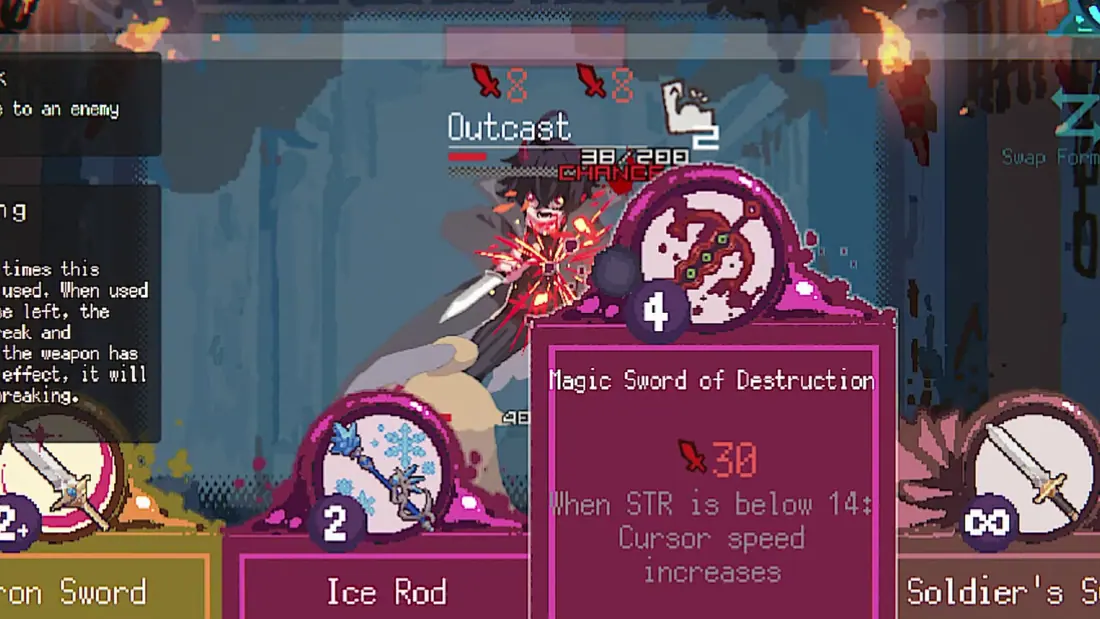
It affects which traits matter. Magic Sword of Destruction's "when STR is below 14, cursor speed increases" is a timing-style downside: the card gets harder to land when your strength is low. In probability style, that line does nothing, so the card is a clean finisher.
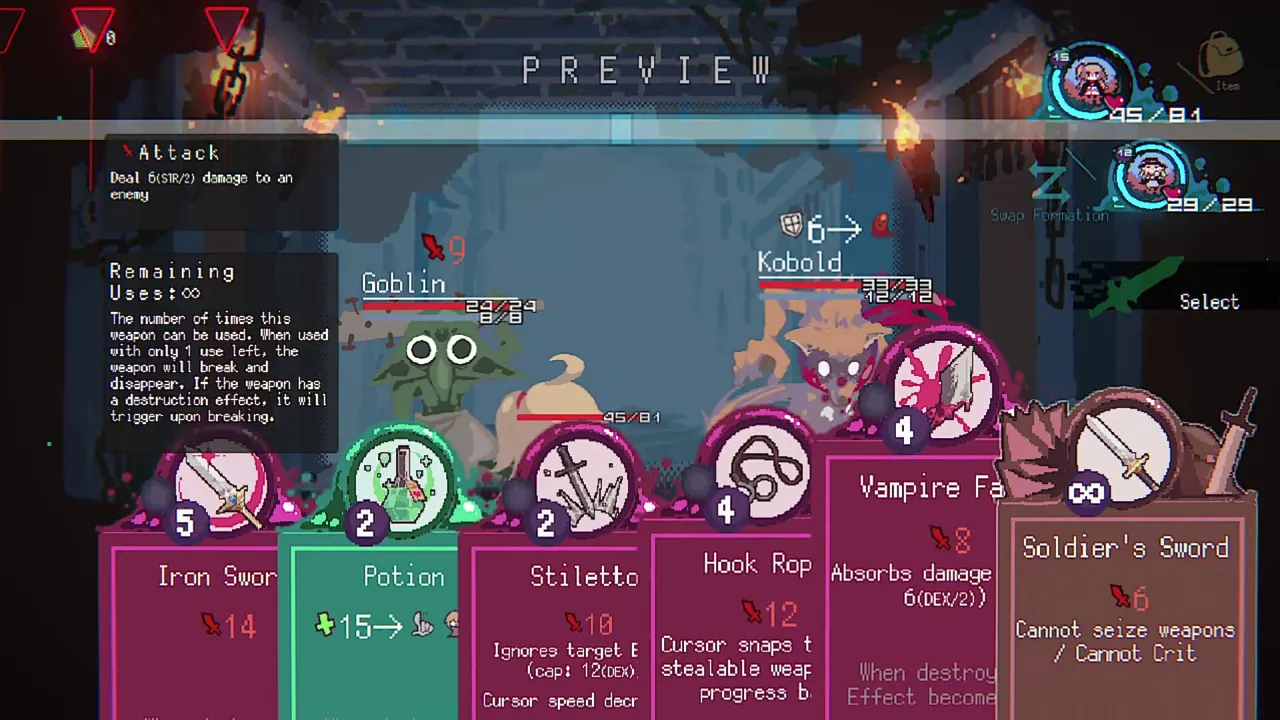
Similarly, "Cannot crit" hurts more in timing, where crits come from precise inputs, and less in probability, where the wheel handles the outcome.
The underlying stagger and damage numbers stay the same. Builds that rely on break timing work in both styles; builds that rely on landing a perfect input are timing-only in practice.
Can you switch styles mid-run?
The demo lets you test both, and there is no indication that the choice is a permanent lock. Treat it as a setting you can change if a boss becomes unbearable, but do not hop between styles every fight: the practice you build is style-specific.
If you do switch, switch at a floor checkpoint, not mid-boss. Relearning the input under a lethal telegraph is how a winnable fight becomes a wipe.
How do Curses interact with each style?
Curses are the great equalizer. In probability, a Curse cancels a failed spin. In timing, a Curse cancels the consequence of a missed input, such as a wasted finisher or a lethal hit.
That means the style with more visible variance, probability, gets more direct value from Curses. Timing players should still hold a buffer, but their Curses are more often spent on survival than on rerolls.
The store describes both as full paths to the ending. If one feels harder, it is harder for you, not harder by design.
Official source: Annihilated on Steam ↗
What does the style choice say about the design?
It says the studio wanted the card economy to be the real game. If the resolution layer were the difficulty, one style would be a compromise. Instead, both styles feed the same stagger math, the same break windows and the same Curse economy.
That is unusual for a card RPG. Most games with a timing layer make it the skill ceiling. Annihilated makes it a preference layer, and puts the skill ceiling in deck construction and break planning.
Which style suits a review playthrough?
For a review, play the style you would choose on a couch. Timing gives a cleaner sense of the combat's rhythm and shows off the animation work. Probability gives a cleaner sense of the economy, because every bad spin is a Curse decision.
If you only play once, pick probability and keep two Curses for bosses. It produces fewer inputs you can personally blame, which makes the six-hour route less frustrating on a first pass.
The combat guide→ explains the shared rules, and the beginner guide→ covers which style to pick on a first run.
FAQ
Is timing style harder than probability?
It depends on the player. Timing demands attention and improves with practice; probability demands Curse budgeting and punishes bad luck. Neither is labeled as the harder mode.
Can you change battle style after starting?
The demo allows testing both, and nothing in the store describes the choice as permanent. Treat it as a setting, but change it at a safe floor.
Do achievements require a specific style?
No achievement list has been published, and the store describes both styles as viable. Do not pick a style for achievements.
Which style is faster?
Neither is confirmed to be faster. Story pacing and route length are the same; only the resolution layer changes.