
Annihilated Combat Guide: Cards, Stagger, Break
How Annihilated combat works: item cards and remaining uses, enemy telegraphs, stagger and BREAK, Fatal Strikes and the two resolution styles.
Quick answer: Every fight is a turn-based card battle where each carried item is a card with limited uses. Enemies announce their next move before acting, and your job is to survive the telegraphed hit while filling the stagger gauge. Once the enemy breaks, a weapon's final use triggers a Fatal Strike.
Combat has two clocks running at once. The first is the enemy's intent: what it will do next turn, shown as text before it acts. The second is your inventory: every card is burning down toward zero uses. Most losses come from ignoring one clock while watching the other.
What is the turn order in Annihilated?
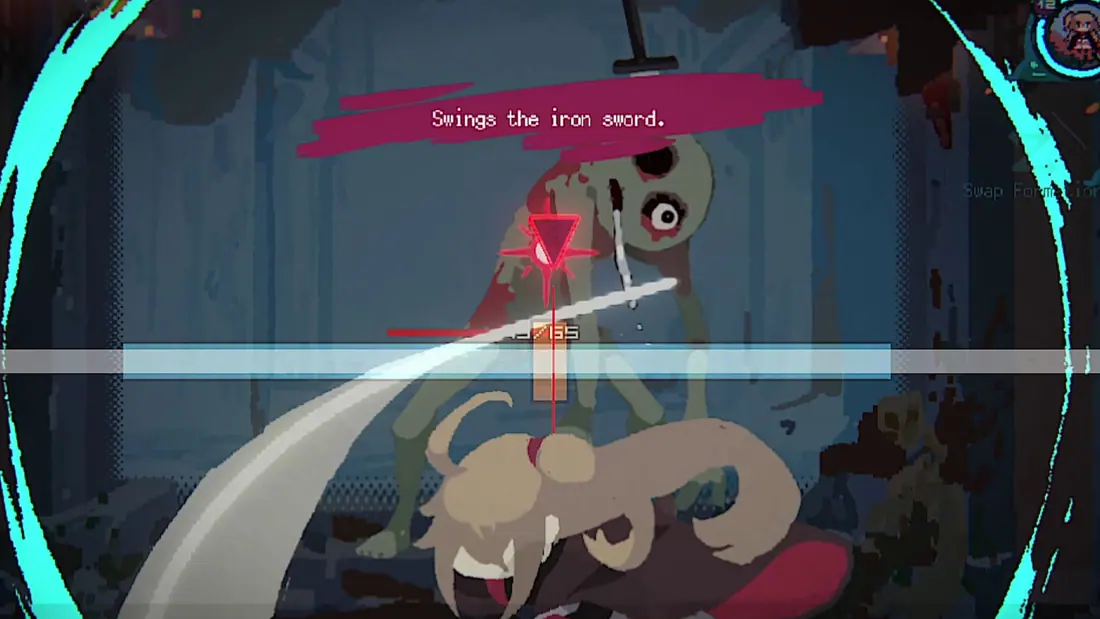
The party acts, then the enemy acts, and the enemy's action is visible during your turn. A Goblin carrying an iron sword will show "Swings the iron sword" before the swing lands. That line is the whole tactical puzzle: you know the damage is coming, so the question is whether to heal, guard, break the enemy's stagger first, or spend a card you were saving.
Your active pair acts together. The partner fights beside you automatically and has their own role: the Hero absorbs or shrugs off lethal punishment, the Priest produces the strongest healing in the game, the Mage reads the situation, and the Warrior hits things that should not be hit.
There is no free attack. Moving, healing and breaking all consume the same turn budget, which is why stagger-focused decks beat raw damage decks in long fights.
How do item cards and remaining uses work?
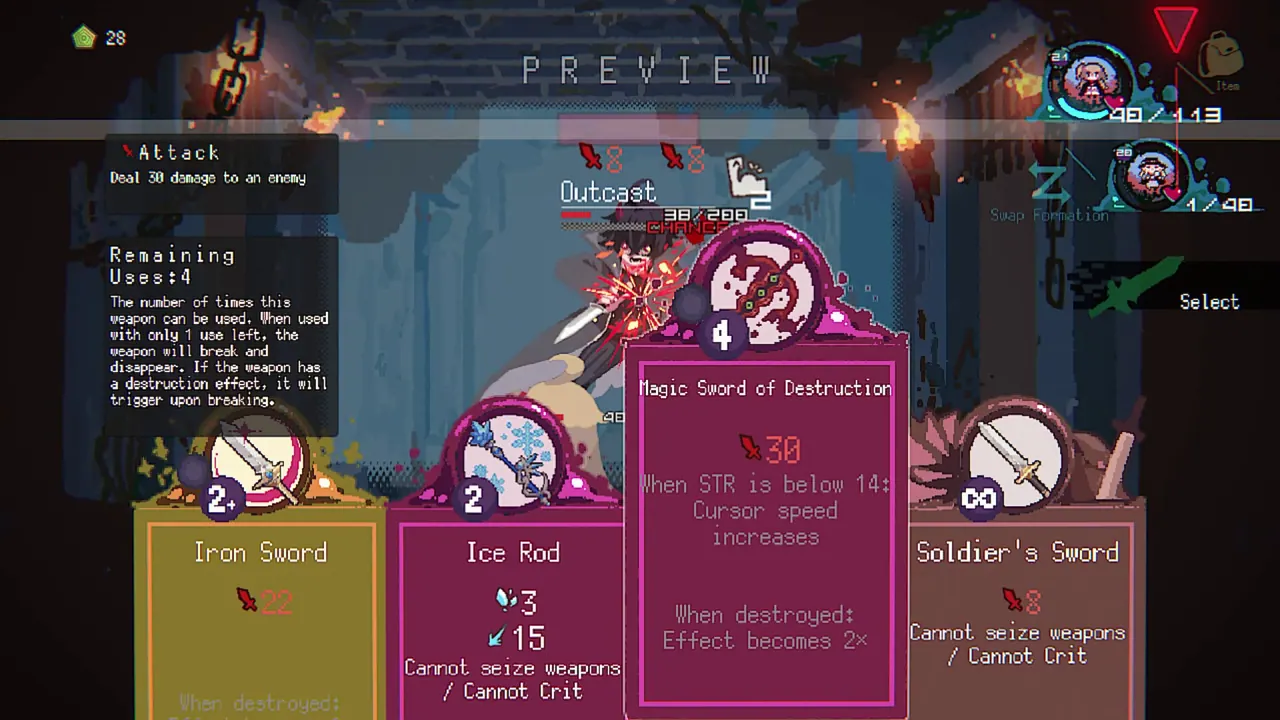
Each item you carry becomes a card. The card face shows damage or healing, special traits, and a remaining-use counter. When the last use is spent, the weapon breaks and disappears. If it has a destruction effect, that effect fires on the break.
The demo cards show the range clearly:
| Card | Uses | Damage | Trait |
|---|---|---|---|
| Iron Sword | 2 | 22 | Straightforward starter blade |
| Ice Rod | 2 | 3 plus 15 heal | Cannot seize weapons, cannot crit |
| Magic Sword of Destruction | 4 | 30 | Cursor speeds up below 14 STR; destruction effect doubles |
| Soldier's Sword | 8 | 8 | Cannot seize weapons, cannot crit |
The important number is not damage per use. It is damage per slot plus what the break gives you. A four-use, 30-damage sword that doubles its destruction effect is a burst package disguised as a normal weapon.
What does stagger do?
Stagger is a second health bar. Damage fills it, and when it fills, the enemy enters BREAK. That state is the Fatal Strike window: finish the broken enemy with a weapon's last use and the hit becomes an execution.
The UI makes the race explicit. You see a break meter with a threshold, such as 33 out of 59, and the boss's stagger gauge, such as 38 out of 200. Those numbers tell you whether this is a two-turn break or a five-turn slog. If your deck cannot fill the gauge before your cards run out, the deck is wrong, not the player.
Stagger also explains why multi-hit and heavy cards are valuable even when their raw damage looks mediocre. A card that adds 12 stagger is worth more than a card that adds 20 damage when the boss has 4,148 health.
What are the enemy types in the opening?
The demo introduces Goblins and Kobolds as regular enemies and The Outcast as the first boss. Their behavior follows the same telegraph rule:
- Goblins are the basic check. They swing, you learn to read the line, and you learn that guarding is a real option.
- Kobolds are the second regular family shown in the demo. Treat both as the tutorial for reading intents, because the habit carries into every later floor.
- The Outcast is the stagger exam. Its health is large enough that chip damage alone will not finish it before your inventory does.
Later floors add more enemies, but the grammar stays the same: read the intent, decide whether to trade, and convert the break into a kill.
Should you guard or race?
Guard when the telegraphed hit would kill a partner or break your last healing card. Race when the enemy is close to a break and you can afford one hit.
The trap is guarding every turn. Guarding preserves health but does not fill stagger, so a defensive deck extends the fight until its own cards expire. The correct rhythm is usually two aggressive turns, one defensive turn, then a break.
The telegraph is free information. If you die to something the game told you was coming, the fix is in the turn before, not in a better weapon.
Official source: Annihilated on Steam ↗
How do the two combat styles change fights?
The game offers timing-based and probability-based resolution. Timing turns a card into an input challenge: stop the cursor, land the swing, hit the window. Probability turns it into a wheel spin, the Dead or Alive, where blue sectors mean success and magenta sectors mean failure.
Mechanically, both route into the same combat math. The difference is where the variance lives. Timing variance is in your hands and improves with practice. Probability variance is in the spin and can be bent with Curses.
Neither style changes enemy health or stagger thresholds. Pick the one whose failure state you find less frustrating, because you will fail repeatedly on the first boss.
How should you build a deck?
Three slots do three jobs:
- Stagger: one heavy or multi-hit card to fill the gauge.
- Finish: one weapon with a strong final use or destruction effect.
- Recover: one heal, preferably a Potion if the Priest is not active.
Everything else is preference. A deck of four damage cards and no heal wins normal fights and loses bosses. A deck of four heals survives everything and kills nothing. The weapons and items guide→ lists the demo cards and what each one is for.
The Fatal Strike guide→ turns Stagger into stolen gear, and the weapons and items list→ explains each card's traits.
FAQ
Does Annihilated use a traditional MP system?
No. Cards use limited uses rather than mana. The resource you manage is the number of times each item can be played before it breaks.
Can enemies be killed without a Fatal Strike?
Yes. Fatal Strikes are the efficient kill, not the only kill. You can grind a health bar down, but you will spend more cards and take more telegraphed hits.
What happens when a weapon breaks?
It disappears and leaves a Curse if it was a cursed item. Destruction effects trigger on the break, which is why the last use is often the strongest.
Is combat random?
Enemy intent is telegraphed, so the tactical layer is deterministic. The resolution layer carries variance depending on whether you chose timing or probability.