
Annihilated Beginner Guide: First Run Setup
A spoiler-light Annihilated beginner guide: the first three decisions, how Curses and item durability work, and the mistakes that cost a run.
Quick answer: Pick one partner and commit, treat weapons as consumable burst rather than permanent gear, and bank Curses for fatal moments instead of small rerolls. Annihilated rewards planned destruction: the last use of a weapon is its strongest, and every broken item leaves a Curse you can spend or forge later.
Annihilated looks like a card RPG and behaves like a resource horror game. Your deck is your inventory, your inventory is finite, and the floor remembers. Three habits carry a first run:
- Count uses, not damage. A 30-damage sword with four uses is four decisions, not one weapon.
- Fight to stagger, not to zero. Stagger opens Fatal Strikes, and Fatal Strikes steal equipment.
- Spend Curses on deaths, not on inconvenience.
What are the first three decisions in Annihilated?
The opening asks who you are, who you carry, and how you want combat resolved. Only the third is reversible in a menu.
Who you are: the last survivor of a rescue party. You have no special power. Your edge is that you keep getting back up, and the game treats that as a mechanic as much as a story beat.
Who you carry: one of four survivors. This locks your route for the run. You will still meet the other three, but the story follows the partner on your back.
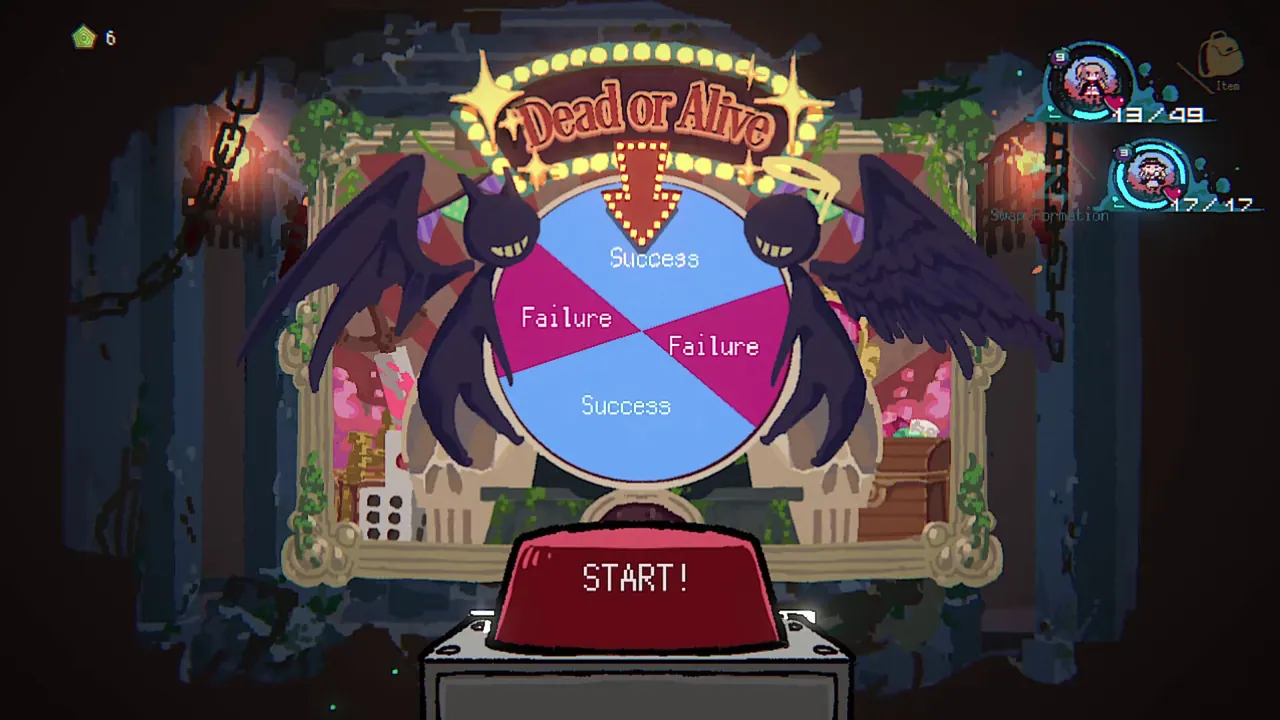
How combat resolves: timing-based or probability-based. Timing asks you to stop a cursor or swing in the right window. Probability asks you to spin the Dead or Alive wheel and live with the sectors. Both reach the end of the game, so pick the one that matches your patience.
If you are unsure about the partner, the partner guide→ breaks down what each one loses and what they give back. Do not pick by tier list alone; the route you can tolerate for six hours matters more than a damage bonus.
How does item durability actually work?
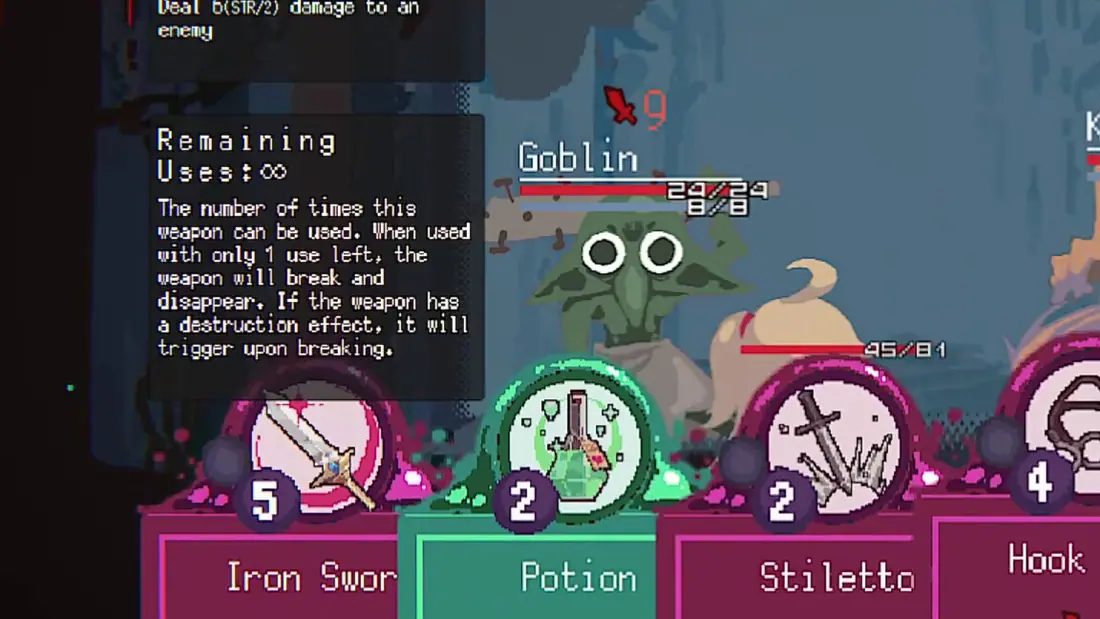
Every item in your pack becomes a card with a limited number of uses. The card shows "Remaining Uses" on its face. When the last use is spent, the weapon breaks and disappears. If the weapon has a destruction effect, that effect triggers at the moment of breaking.
This is not a durability tax. It is the core damage engine:
- The final use of a weapon is its strongest moment.
- Breaking a weapon on a staggered enemy can trigger a Fatal Strike instead of a normal hit.
- The break leaves a Curse, which is a resource, not a penalty.
Example from the demo: Iron Sword is a two-use, 22-damage card. Magic Sword of Destruction is a four-use, 30-damage card that speeds up the cursor when your STR is below 14 and doubles its destruction effect. The second card is not "better" in a vacuum; it is a longer fuse with a bigger explosion at the end.
Should you hoard or break weapons?
Break them, but on purpose. A hoarded weapon is dead weight by the next floor, because enemy health scales faster than your stash. The useful rule is:
- Keep one panic button: a heal, a guard or a high-stagger card.
- Spend the rest freely on normal encounters.
- Save the last use of a heavy weapon for a staggered elite or boss.
Potions are the exception. A Potion is a heal that costs a card slot, and running out of healing is the most common cause of a death spiral. Two Potions is a comfortable buffer; four is a wasted deck.
How should you spend Curses?
Curses come from broken items and from certain story choices. They do three things:
- Defy fate: cancel the worst result of a roll or a lethal hit. This is the emergency button.
- Forge: convert stored Curses into an item you need. This is how you recover from a bad inventory.
- Convert to experience: leftover Curses become progression at the end of a run.
For a first run, hold two Curses and spend the rest on forging. Defy fate is only worth it when the alternative is losing a floor's progress. Using it to reroll a mediocre attack is how new players run dry before the boss.
The Curse system guide→ covers the exact trade-offs and when converting beats forging.
It cancels one outcome, not a whole turn. If three things go wrong in a round, the Curse saves you from one of them.
Official source: Annihilated on Steam ↗
What happens when you die?
Death returns you to the floor where you fell rather than restarting the dungeon, and your stored Curses persist. The store does not spell out exactly what happens to the rest of your pack, so treat a retry as a chance to change one variable rather than as a full reset: a different weapon in the deck, a different opening turn, or a different partner placement. Repeating the same turn order into the same telegraph is how a floor becomes a wall.
If a boss kills you three times, stop upgrading damage and look at your stagger output. Most walls in the opening are stagger checks wearing a health bar.
Which battle style is easier for beginners?
Timing is more forgiving early because the window is visible. Probability is more forgiving late because a bad sector can be offset by Curses and because it does not punish tired hands.
Try both in the demo. If you find yourself blaming the cursor, switch to probability. If you find yourself blaming the wheel, switch back. Neither style has a hidden ending or a damage penalty.
What should you avoid in the first hour?
- Do not sell or discard a weapon just because its damage number is low. Stagger and utility matter more than the tooltip.
- Do not spend Curses on the first floor's random encounters.
- Do not split healing between two partners. The Priest heals best; if the Priest is not in your active pair, carry Potions.
- Do not read route guides before the split. The choice is the point, and the routes are short enough to replay.
Once the first floor clicks, read the combat guide→ for turn order and the Curse system→ before you break your first weapon.
FAQ
How long is a first run in Annihilated?
Each route is roughly six hours, according to the store. A first run with deaths and exploration will run longer than a focused replay.
Can you carry more than one partner out?
No. The premise is that only one survivor can leave with you. That choice defines the route.
Do you lose Curses when you die?
Stored Curses are the part of your progress that persists through death. The run's carried items are what you lose.
Is there a difficulty setting?
The store does not list one. The two battle styles are the closest thing to a difficulty choice, and both are viable.